LetterGrid is a free daily word puzzle: guess the hidden word in six tries, using green, yellow and gray tiles to close in on it. Play in English, French, Spanish, Portuguese, Russian or Arabic, with a shared daily word, unlimited 4–6 letter practice and a three-minute Blitz.
How do you play LetterGrid online?
- 1Choose a word language on the menu. It starts on the language of the page and changes both the words and the on-screen keyboard.
- 2Pick a mode: Daily word (one 5-letter word per day), Practice (unlimited words of 4, 5 or 6 letters) or Blitz (as many 5-letter words as you can solve against the clock).
- 3Type a guess with the on-screen keyboard or your own keyboard and press Enter. It has to be a real word of the right length.
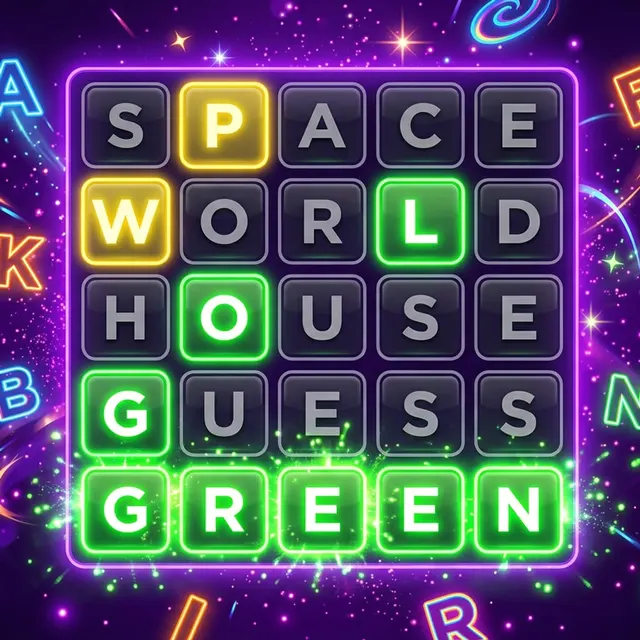
- 4Read the tiles: green means the letter is in the right spot, yellow means it is in the word but somewhere else, gray means it is not in the word.
- 5The keyboard keeps the same colours, so you can see at a glance which letters are confirmed, possible or ruled out.
- 6Solve the word within six guesses. After the round you can share a spoiler-free emoji grid or look the word up in Wiktionary.
Controls
| Action | Desktop | Mobile |
|---|---|---|
| Type letter | Keyboard or on-screen keys | On-screen keyboard |
| Delete | Backspace | ⌫ key |
| Submit guess | Enter | Enter key |
What are the rules of LetterGrid?
- –Every word gets six guesses. A guess must be in the game’s word list for that language and length; if it is not, the row shakes and no attempt is used.
- –Repeated letters are scored one copy at a time: exact matches are marked first, and an extra copy only turns yellow if the answer really contains that letter again.
- –The Daily word is the same for every player on the same word language and changes at midnight in your own time zone. Puzzle #1 was 1 January 2026.
- –Your daily streak grows by one for each consecutive day you solve the daily word; a missed day or a failed puzzle resets it.
- –Hard mode (Settings) requires green letters to stay in place and every revealed letter to be used again. It cannot be changed in the middle of a word, and a shared Hard mode result carries an asterisk.
- –Practice allows up to two hints per word. Each hint reveals one letter in its correct position that you have not already found.
- –Blitz starts at 3:00. A solved word scores 7 minus the guesses used and adds 20 seconds; an unsolved word is revealed and replaced with no bonus; Skip costs 10 seconds.
What are the best tips for winning at LetterGrid?
- –Open with common letters. In the English answer list, E appears in about half of the five-letter words and A and R in roughly two out of five, which is why starters such as ALERT, CRATE or TRACE clear a lot of ground.
- –Change the language, change the opener: French answers lean heavily on E, Spanish and Portuguese on A and O, Russian on А and О. ACIER (French), CORAL (Spanish), PORTA (Portuguese) or ОКЕАН (Russian) test several of them at once.
- –Keep repeated letters in mind. More than a quarter of the English five-letter answers contain a letter twice, so when the clues stop adding up, try a double.
- –Use your second guess to test fresh letters rather than repeating greens — five new letters usually tell you more than a word that only confirms what you know. (Hard mode does not allow this, which is what makes it hard.)
- –In Blitz, speed beats perfection: a four-guess solve is worth 3 points plus 20 seconds, and the time bonus is what keeps a run alive. Skip a word that is not opening up instead of spending a minute on it.
- –Save Practice hints for the last stubborn position. A hint only reveals a letter you have not already placed, so it is worth most once the rest of the row is green.
What is LetterGrid?
LetterGrid belongs to a family of deduction games much older than the browser. Jotto, a pencil-and-paper game from the 1950s, had players work out a secret five-letter word from how many letters their guesses shared with it; the board game Mastermind did the same with coloured pegs; and in 2021 Josh Wardle’s Wordle turned the idea into a once-a-day habit with coloured tiles and a spoiler-free grid to share, before The New York Times bought it in 2022. LetterGrid keeps that core loop and builds on the parts players ask for most. The first is language. The game ships six word packs — English, French, Spanish, Portuguese, Russian and Arabic — each with its own hand-picked list of everyday answers, its own dictionary of accepted guesses and its own keyboard: AZERTY for French, a Ñ key for Spanish, the Russian ЙЦУКЕН layout, and an Arabic layout whose rows read from right to left. Accents are ignored, so nobody has to hunt for É or Ç, while letters that change a word, such as Spanish Ñ or Arabic ة, keep their own keys. The English pack accepts more than 8,600 five-letter guesses from the public-domain ENABLE word list but only picks answers from about 700 common words, so the daily word is always something you can reasonably know. The second is pace. The Daily word is a shared five-letter puzzle that saves your progress in the browser, so you can close the tab and continue later. Practice removes the limit, lets you switch between four-, five- and six-letter words and offers a couple of hints. Blitz puts a three-minute clock on the screen and rewards quick, clean solves with extra time. Statistics are kept separately for each language and mode — games played, win percentage, current and best streak, and a guess distribution — and everything runs locally, with no account.