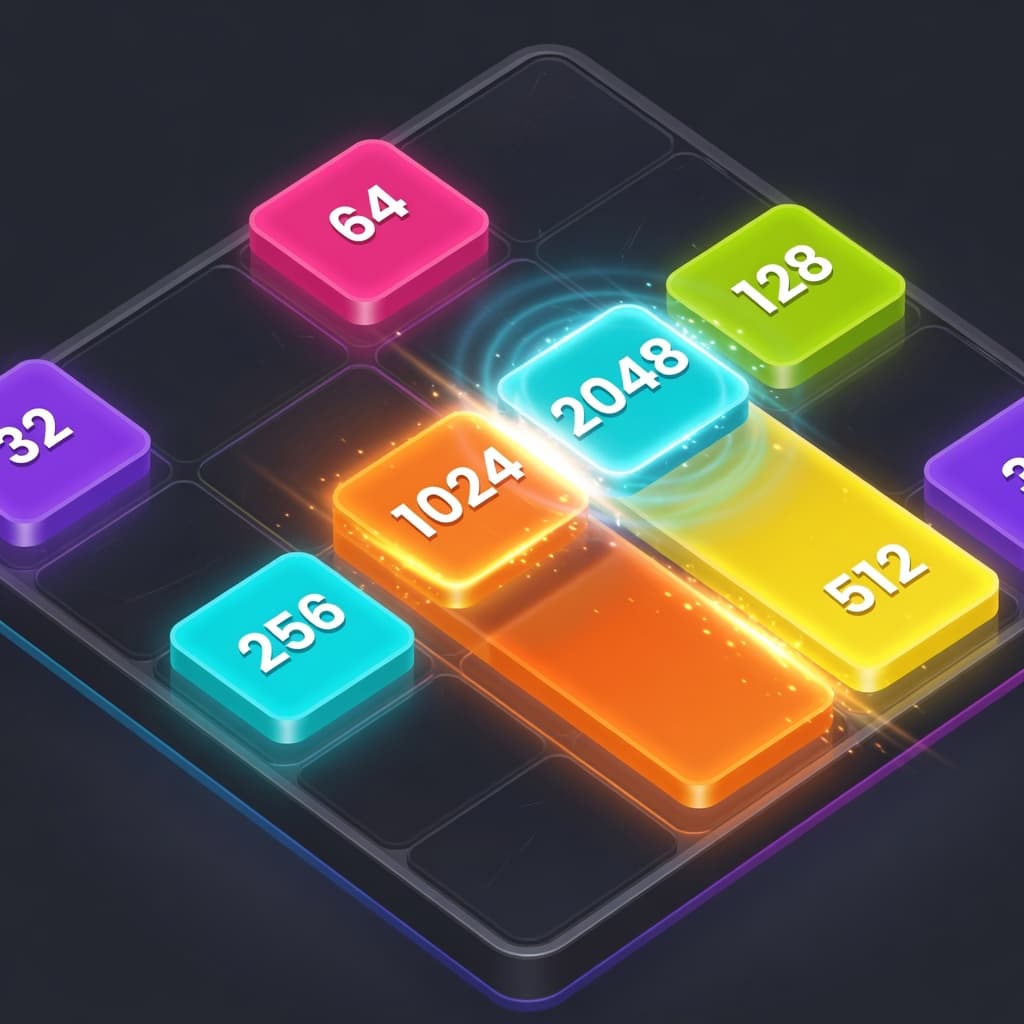
2048 has one of the shortest rule sets of any puzzle game: slide all the tiles on a 4×4 board in one direction, and two tiles with the same number merge into one with their sum. After every move a new tile appears. Reach a tile showing 2048 and you win. Most players get stuck around 512 or 1024 because they play move by move. Winning consistently comes from a plan, and the plan is surprisingly simple.
A weekend project that went viral
The Italian developer Gabriele Cirulli, then 19, wrote 2048 over a weekend and released it as open-source software in March 2014. It was inspired by an earlier game called 1024 and is conceptually similar to Threes, and within weeks it had spread across the web and app stores in countless versions (Wikipedia)).
How new tiles appear
After every move that changes the board, a new tile appears in a random empty cell. In the original game, and in the PapoGames version, it is a 2 nine times out of ten and a 4 one time out of ten. You cannot control where it lands, so a good strategy is one that stays safe wherever the new tile falls.
The corner strategy
Choose one corner, for example the bottom-left, and keep your largest tile there for the whole game. Every move should either keep it there or bring other tiles towards it. In practice you will use only three directions most of the time: for a bottom-left corner, that is down, left and right. Up is the move to avoid.
- Down and left are your main moves: they push tiles towards the corner.
- Right is the third move, used when down and left do nothing.
- Up only when there is truly no other legal move. It lifts your big tile out of the corner, and a 2 can drop into the gap.
Build a chain, not a pile
Keep the bottom row full and in decreasing order away from the corner, for example 256, 128, 64, 32. Then continue on the row above in the opposite direction, so the tiles form a snake. When a new tile matches the end of the chain, everything collapses towards the corner in a cascade: 32 + 32 makes 64, which merges with 64, then 128, and so on.
Keeping the bottom row full matters more than it sounds. A full row cannot slide left or right, so pressing left or right moves only the rows above and your chain stays in place.
Five rules that save games
- Never let small tiles get trapped behind big ones in the corner row. A 2 stuck between 512 and 256 is very hard to remove.
- Merge small tiles early. Plenty of 2s and 4s scattered around fill the board quickly.
- Look one move ahead. Before swiping, check where empty cells will open and where a new tile could land.
- Prefer moves that merge. A move that only slides tiles without merging uses up space.
- Slow down near the top. Above 512, one careless swipe can ruin a long game.
When the board is almost full
If your big tile leaves the corner, do not panic and do not try to fix it with more random moves. Look for the move that gets it back in one step, usually the opposite of the move that moved it. If the corner is taken by a small tile, build a merge onto that tile so it grows and joins the chain. With only one or two empty cells left, choose the move that creates the most merges, not the one that looks tidiest.
After 2048
Reaching 2048 takes the equivalent of 1,024 twos merged into a single tile, so it is a real achievement. Many versions let you keep going to 4096 and beyond, and the same corner strategy applies. The challenge becomes space: you need more of the board for the chain while leaving room to work.
Play 2048 on PapoGames
Our free 2048 runs in any browser with swipes on a phone or arrow keys on a computer. It saves your best score, has an Undo button for your last move, and lets you continue playing after you reach the 2048 tile. Use Undo as a learning tool: when a move breaks your corner, undo it and look for the move you should have made. For another relaxed number puzzle, try Number Match.