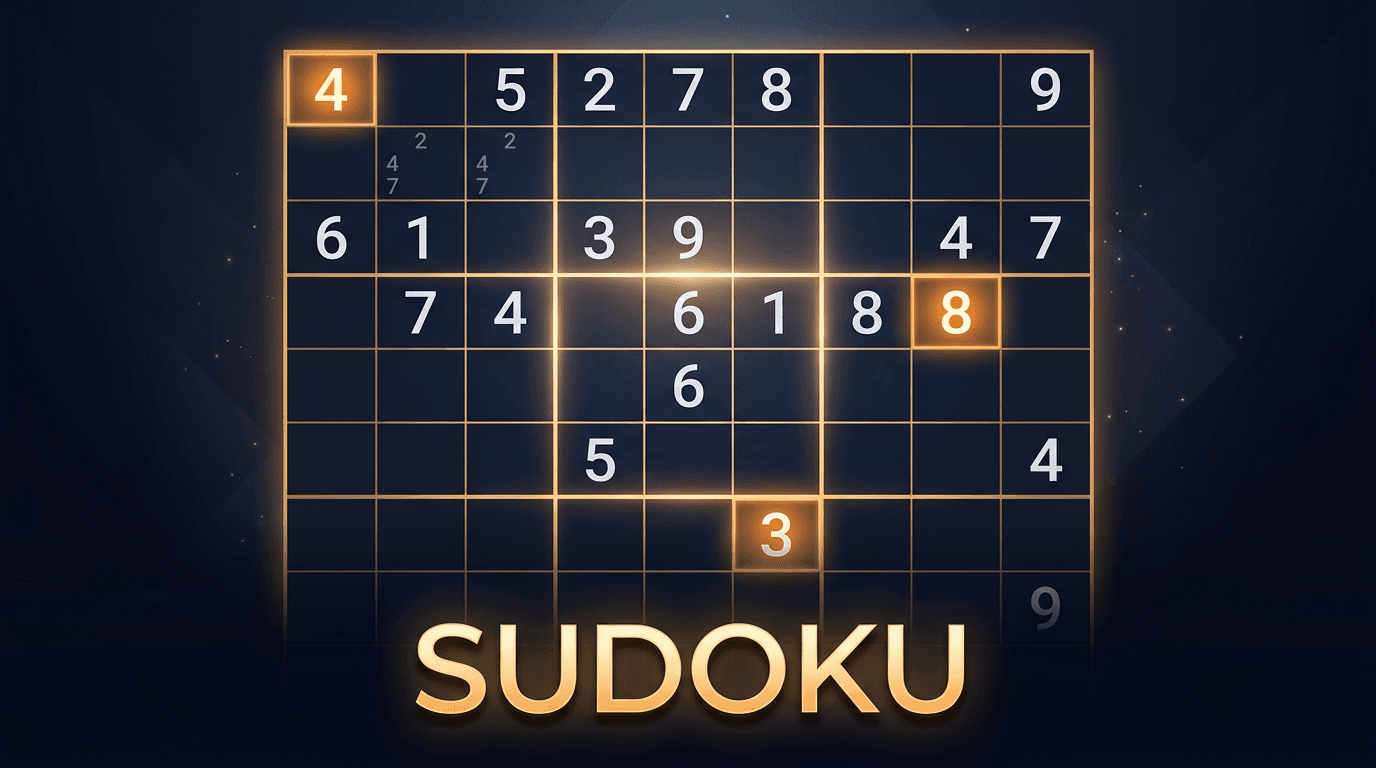
Sudoku looks like a maths puzzle, but it uses no arithmetic at all. The digits 1 to 9 are just nine different symbols, and the only rule is that each one appears exactly once in every row, every column and every 3×3 box. A well-made puzzle has exactly one solution, which means every number can be found by logic. This guide covers the seven techniques that solve almost every puzzle, in the order you should learn them.
Where Sudoku comes from
The modern puzzle was first published in 1979 by Dell Magazines in the United States under the name "Number Place", and is usually credited to the puzzle designer Howard Garns. The Japanese publisher Nikoli popularised it in the 1980s and gave it the name Sudoku, short for a phrase meaning "the digits must remain single". It became a worldwide newspaper craze in 2005 (Wikipedia).
How few starting numbers can a Sudoku have? In 2012 mathematicians Gary McGuire, Bastian Tugemann and Gilles Civario used an exhaustive computer search to show that no valid puzzle has fewer than 17 clues (Wikipedia). Fewer clues does not always mean harder, though: difficulty depends on which techniques the puzzle forces you to use.
Beginner techniques
1. Scanning (cross-hatching)
Pick a digit, say 5, and look at one 3×3 box that does not contain it yet. Every 5 in the same rows and columns as that box rules out cells inside it. Draw imaginary lines through those rows and columns. If only one empty cell in the box is left, the 5 goes there. Scan the whole grid this way for each digit from 1 to 9 before trying anything else: on Easy puzzles, scanning alone often finishes the grid.
2. Naked single
Now look at a single cell instead of a single digit. Check its row, column and box and list which digits are already used. If eight of the nine digits are taken, the remaining one must go in that cell. This is the main technique when a row or box is almost full.
3. Hidden single
A cell can have several candidates and still be solved. If, inside one row, column or box, a digit fits in only one cell, it goes there, even if that cell could also take other digits. Hidden singles are the most common step in Medium puzzles, and they are easy to miss because the cell itself looks undecided.
Intermediate techniques
4. Pencil marks (candidates)
When scanning stops working, write the possible digits in small numbers in each empty cell. This is not guessing: it is bookkeeping that lets you see the patterns below. Fill in candidates carefully, because one missing candidate can lead you to a wrong deduction. Every time you place a digit, remove it from the candidates in its row, column and box.
5. Naked pairs
If two cells in the same row, column or box both have exactly the same two candidates, for example 3 and 7, then those two digits must go in those two cells, in one order or the other. You do not know which yet, but you can remove 3 and 7 from every other cell in that unit. The same idea works with three cells sharing three candidates (a naked triple).
6. Pointing pairs
Inside a box, suppose the only possible cells for the digit 4 are both in the same row. Wherever the 4 goes in that box, it will be in that row. So the 4 cannot appear anywhere else in that row outside the box, and you can erase it from those cells. This links boxes to rows and columns and often breaks a stuck Hard puzzle open.
Advanced technique
7. X-Wing
Look for a digit that has exactly two possible cells in each of two different rows, and those cells line up in the same two columns, forming the corners of a rectangle. The digit must sit on one diagonal of the rectangle or the other. Either way, it occupies both columns, so you can remove it from every other cell in those two columns. The same logic works with columns and rows swapped.
| Difficulty | Techniques usually needed |
|---|---|
| Easy | Scanning and naked singles |
| Medium | Adds hidden singles and pencil marks |
| Hard | Adds naked pairs and pointing pairs |
| Expert | Adds X-Wing and longer candidate chains |
The table is a general guide. Different puzzle generators grade difficulty differently, so an "Expert" puzzle on one site may feel like a "Hard" one on another.
Five habits of fast solvers
- Start with the digits that already appear most often in the grid: they have the fewest places left.
- Do one full scanning pass before writing any pencil marks.
- After every placed digit, check its row, column and box for a new single: one number often unlocks the next.
- Never guess. If you are stuck, you have missed a single or a candidate, so recheck before reaching for an advanced technique.
- When you make a mistake, find out why. Usually it is a candidate you forgot to remove.
Practise on PapoGames
Our free Sudoku runs in your browser with four levels: Easy, Medium, Hard and Expert. It has a Notes mode for pencil marks, Undo and Erase buttons, and hints that each cost points from your score. Three mistakes end the game, which is a good reminder to deduce instead of guessing. Your times and win rate are saved in your browser. If you prefer number puzzles with a different twist, try Number Match.
A simple training plan: solve two Easy puzzles using only scanning and singles, with no notes. When that feels quick, move to Medium and use notes only after a full scanning pass.