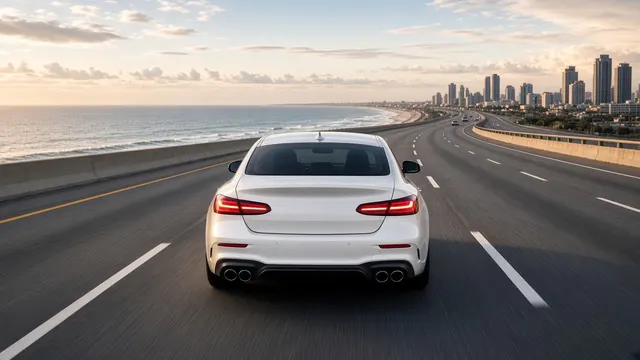
Highway Traffic is a freeway driving game. You steer through five lanes of same-direction traffic, accelerate on the open road, brake for a tight gap, and try to last. One real collision ends the run.
How do you play Highway Traffic online?
- 1From the menu, choose Endless for a fresh road or Daily Road for the traffic pattern tied to today’s UTC date.
- 2Steer with the left and right arrows or A and D. The car does not snap between lanes; it slides, and it slides less willingly as the speed climbs.
- 3Hold the up arrow or W to accelerate, and the down arrow or S to brake. Releasing both lets the car settle back toward the rising cruise pace.
- 4Q looks left and E looks right along the freeway. The camera recenters when you let go. P pauses, and hiding the browser tab pauses too.
- 5On a touch screen, drag across the view to steer. Gas and Brake sit at the bottom corners. A close pass raises a chain; letting the chain expire drops it.
What are the rules of Highway Traffic?
- –Traffic travels the same direction as you. Sedans, SUVs, vans, sports cars and trucks hold their lanes at different speeds, and a faster car will queue behind a slower one instead of driving through it.
- –Every so often four of the five lanes close together. The open lane stays within two lanes of the previous opening, so you can reach it if you start moving early.
- –The collision box sits slightly inside the car you see. A mirror-to-mirror brush can survive. A real overlap ends the run immediately, with no spare lives.
- –The score counts one point per metre, ten points for each car you pass with room to spare, and a close-pass chain of 25, 50, 75 and so on up to eight links. The chain fades if 2.2 seconds pass without another close pass.
- –Braking bottoms out near 45 km/h. The open-road pace starts near 90 km/h and rises toward 150 km/h over four kilometres. Holding accelerate can reach about 166 km/h.
What are the best tips for winning at Highway Traffic?
- –Read the gap one cluster ahead and be in that lane before the cars fill the windscreen. A full-speed swerve starts later than it looks.
- –Brake while you are still aligned with the opening. Steering and braking together is how a truck’s flank catches the side of the car.
- –A centered pass in the next lane is safe. Move toward a car only when you want the close-pass chain, and straighten as soon as you are past.
- –Daily Road repeats. A crash near the same gate is information about that gate, not a reason to change mode.
What is Highway Traffic?
Highway Traffic is built for the feeling of a crowded freeway rather than a three-lane arcade hop. The camera sits behind the car. Steering is continuous, so a late correction costs more at speed than it does in the first kilometre, and the brake is a real tool: drop speed to thread a gap, then get back on the gas once the lane is yours. Trucks are wider and slower than the cars around them, which is why sitting beside one feels tighter than the lane lines suggest. The road itself changes every 750 metres. Pacific Coast, City Expressway, Red Desert, Rain Forest, Alpine Pass and Midnight Metro each use their own photograph as the landscape on both sides of the road, and the light and fog move with that photograph. Rain falls through the forest and the asphalt shines. Snow crosses the alpine pass. After dark the city windows stay lit and the road looks wet. Endless mode deals a new pattern every run. Daily Road uses the calendar date in UTC, so two people playing on the same date meet the same traffic and can compare distance honestly. Best distance, best score, the day’s Daily Road distance, the selected paint and the sound setting stay in this browser. The four paints, pearl, navy, red and graphite, change only the look of your car. Nothing here asks for an account, and a crashed run is retried with R from the result card or with Drive again.