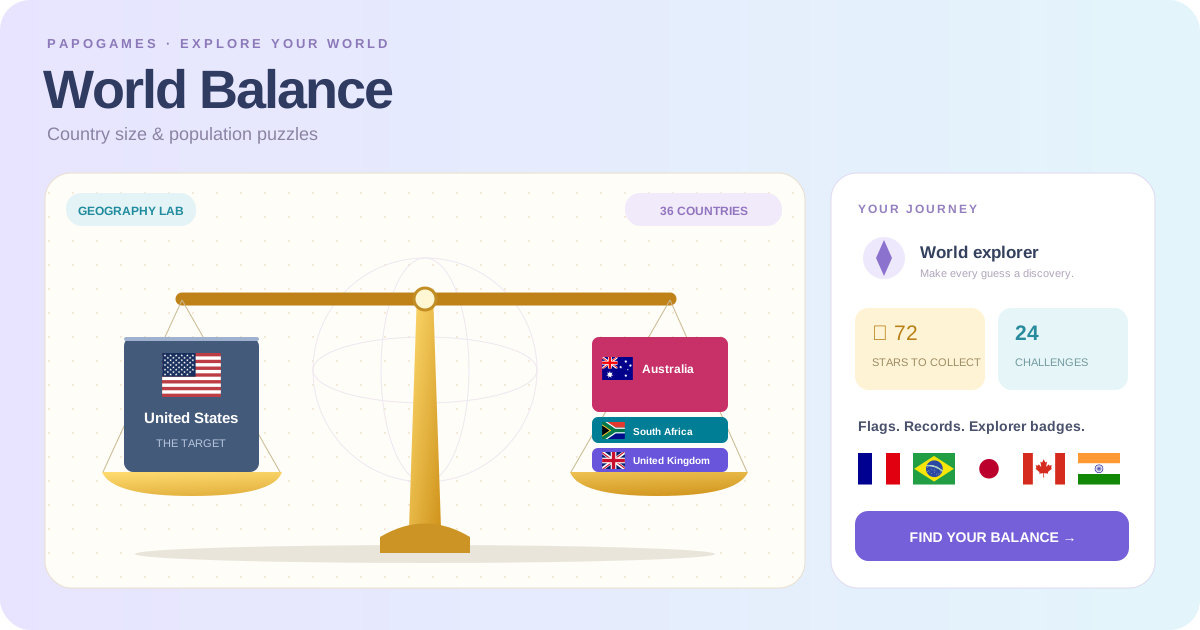
World Balance is a free country size and population game that turns geography into a hands-on puzzle. A country anchors the left side of a scale. Your task is to combine other countries on the right until their total comes close, without passing the target. Switch between land area and population challenges, earn stars, and discover surprising comparisons at your own pace.
How do you play World Balance online?
- 1Read the challenge label first: land area uses square kilometres, while population counts people. The target country and its value appear on the left pan.
- 2Search for a country by its English name, or browse the country cards. Select a card to add it to your combination. You can use up to five different countries.
- 3Watch the beam and percentage change. Select a country in your combination to remove it. You can experiment freely before checking your answer.
- 4Choose Check balance when you are ready. Reach at least 85% of the target without exceeding 100% to earn a star. Then try another challenge or improve your answer.
- 5Enable study mode to see the numbers on every country card. A hint names one country in a strong three-country combination; revealing the full solution makes that attempt a practice attempt.
What are the rules of World Balance?
- –The target country cannot be selected, and every country can appear only once in a combination. Five countries is the maximum.
- –A total from 85% to below 97% earns one star. From 97% to below 99.5% earns two stars. From 99.5% through 100% earns three stars. Going above 100% earns no stars. You can check an overweight combination to see the complete breakdown, then adjust it.
- –Every challenge has a three-country solution worth three stars. You may find a different solution using fewer or more countries.
- –All challenges are available from the start. There is no timer, account requirement, purchase, or penalty for changing your selection.
- –Your best star result for each challenge stays in this browser when storage is available. Revealed solutions do not award new stars. Your player dashboard keeps your name, avatar, checked attempts and personal best percentages on this device.
What are the best tips for winning at World Balance?
- –Start with a country smaller than the target but large enough to fill most of the gap. Add smaller countries to make finer adjustments.
- –An answer just over the target does not count. Remove a country and replace it with something slightly smaller.
- –Try the same idea in both measures. Land area and population are different quantities; population density is not a scoring mode.
- –Use study mode to learn the data first, then hide the card values and try estimating from memory.
What is World Balance?
A large country does not necessarily have a large population. World Balance makes that distinction tangible: one challenge asks how much surface a group of countries covers, while another asks how many people live there. The same selection can behave very differently on the two scales. This geography puzzle includes 36 countries from several continents and uses a fixed 2023 World Bank snapshot for both measures. Land area excludes inland water and is expressed in square kilometres; population is an estimate of the number of residents for that year. Values follow the World Bank’s statistical coverage and should not be treated as a statement about territorial claims. Displayed totals are rounded for readability, but the game calculates balance from the full stored values. Population estimates can be revised, so these are learning comparisons rather than live demographic figures. The complete data attribution is available inside the game. A colorful globe-inspired dashboard, flag cards and a gold balance scale help you explore scale and proportion. Browse all 24 challenges as destination cards, unlock three explorer badges through your progress, and inspect each country’s contribution in the result breakdown. Personal bests belong to your local profile; no online rankings are claimed. You can use the game as a short geography break, a classroom estimation exercise, or a way to practise adding large numbers. There is no rush: build a rough estimate, check the percentage, and refine it until the beam settles near the middle.