
Picture a squad of computer-controlled teammates that you command by talking to them, not by tapping a menu. That is the idea behind Teammates, a first-person shooter Ubisoft built as a research project and shared with “a few hundred players in a closed playtest”. Ubisoft describes it as a test of what natural speech can do in a game, and says its writers set the limits for how far the characters may improvise. You cannot buy it, which is the first thing worth knowing about AI in games in 2026: the most exciting demos are often not products yet.
Plenty of AI is already in the games you play. It upscales your picture, moderates voice chat and helps studios test builds. This guide sorts the field into four labels you will see throughout: released (in games players can get), developer tool (available to studios), announced (promised, not shipped) and research (a lab result). We checked every example against its primary source on 21 November 2026.
What is AI in video games?
“AI” covers several different things, and mixing them up is how most misleading headlines happen.
- Traditional game AI is hand-written logic: enemies that follow routes, call for backup or flee at low health. It is predictable by design. Our chess and checkers opponents work this way, searching possible moves and scoring the results, as does the computer player in tic-tac-toe.
- Machine learning trains a system on examples instead of writing every rule by hand. Upscaling, voice moderation and some testing bots use it.
- Neural networks are the model type behind most modern machine learning, loosely inspired by how neurons connect.
- Generative AI produces new text, images, audio, video or code from a prompt. Language models and image generators are the familiar examples.
- AI-powered NPCs are non-player characters whose speech or decisions come partly from a model, not a fixed script.
- Procedural content generation builds levels or terrain from rules and random seeds. It is older than today’s generative AI and does not need a neural network.
10 ways AI is changing video games in 2026
1. Smarter NPCs and more realistic characters
Status: released in a few games, tested in more. NVIDIA’s ACE autonomous game characters use small language models so a companion can talk, share loot and fight. NVIDIA names PUBG: Battlegrounds (the PUBG Ally teammate), inZOI (self-directed “Smart Zoi” characters) and NARAKA: Bladepoint (AI teammates running local inference). Not every named game has the feature live for everyone: inZOI is in Early Access, and PUBG Ally has been reported as in testing. For players it means a companion that reacts to what you say. For developers it means a new kind of character to design and test.
2. Dynamic game worlds and adaptive environments
Status: mostly classic AI, with learning systems announced. Games have adapted for years. Valve’s Left 4 Dead used an “AI Director” to adjust pacing, and the idea is still common. What is new is learning. NVIDIA describes MIR5 bosses that “learn from past player encounters”, but gives no release date. Treat learning bosses as promising and unproven at scale.
3. AI-generated game content and worlds
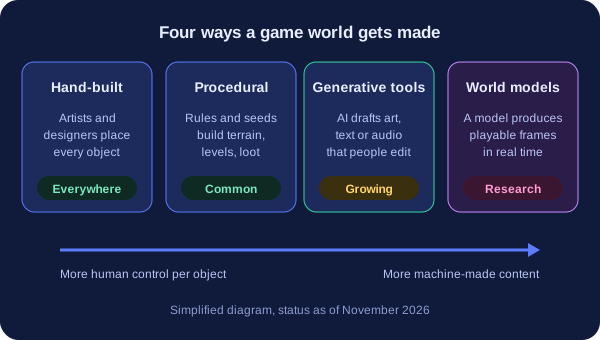
Status: generative tools are shipping; world models are research. Valve’s Steamworks content survey asks developers to disclose AI-generated content that ships to players, including content generated live while the game runs (with the guardrails used), but not AI used only for efficiency inside a studio. At the research end, Google DeepMind’s Genie 3 generates an explorable world from a text prompt at 720p and 24 frames per second, but stays consistent for only a few minutes, and DeepMind’s announcement calls it a limited research preview (check DeepMind for any wider access). Microsoft’s WHAM research, also called Muse, generates gameplay for brainstorming and has published model weights for researchers. Neither is a way to play a finished game today.
4. Personalised gaming experiences
Status: partly released, mostly modest. Recommendation lists, adaptive difficulty and tutorials that respond to mistakes are the realistic forms of personalisation. Public evidence for games that rewrite their story around each player is thin. The honest summary is that personalisation works best when it makes a game easier to start, such as better suggestions or gentler early levels, and worse when it quietly changes what a game is.
5. More realistic conversations and dialogue
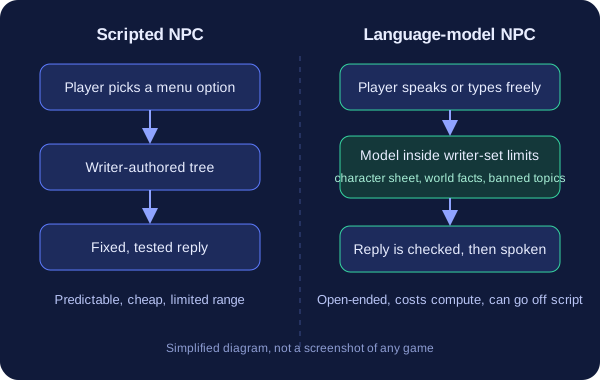
Status: released in limited cases. Epic’s AI-voiced Darth Vader in Fortnite (May 2025) showed both sides: a talking character that thrilled players and one that players quickly tricked into swearing, which led to a hotfix. NVIDIA also lists Dead Meat, where players interrogate suspects by voice or keyboard and the AI writes the replies. The lesson is that free-form dialogue needs guardrails and testing as much as it needs a clever model.
6. AI-assisted game development
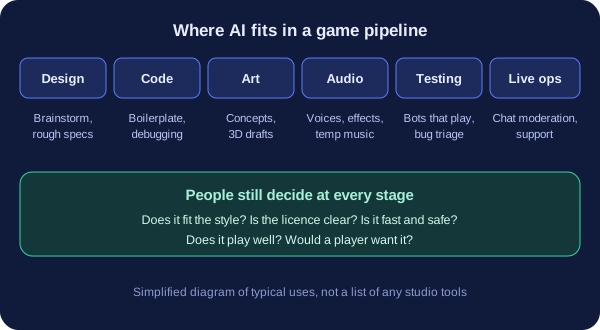
Status: widely used, divisive. The GDC 2026 State of the Game Industry survey found 36% of game professionals use generative AI at work, mostly for research and brainstorming (81%), code assistance (47%) and prototyping (35%). Yet 52% said it is hurting the industry, up from 30% a year earlier. Engines are adding assistants: Unity offers an in-editor assistant (currently in beta), and Epic said Unreal Engine 5.7 would bring its Developer Assistant into the editor as an experimental tool. Our guide to the best AI tools for game developers compares them.
7. Better graphics, animation and visual effects
Status: released. This is the most mature use of AI in games. NVIDIA’s DLSS 4.5 uses a second-generation transformer model for Super Resolution on GeForce RTX GPUs and adds Dynamic Multi Frame Generation for RTX 50 Series cards, which creates extra frames between rendered ones. For players it means smoother games on the same hardware. The trade-off is that generated frames are not rendered frames, so image quality and input response depend on the game and settings.
8. Improved game testing and bug detection
Status: developer tool and research, mainly in large studios. EA’s SEED research group has published work on reinforcement-learning agents that play builds to find bugs, including a paper on the practical difficulties of deploying them in Battlefield and Dead Space. It presents the agents as an addition to existing scripted bots. Players benefit indirectly, through fewer crashes and exploits at launch.
9. Smarter multiplayer and moderation systems
Status: released. Call of Duty uses Modulate’s ToxMod to flag harmful voice chat. According to Activision’s support page, the system listens for harmful behaviour rather than keywords, sends reports to Activision (people decide on enforcement), covered English, Spanish and Portuguese at launch, and players who do not want voice chat recorded can turn voice chat off. Public detail on machine-learning cheat detection is much scarcer, so be cautious about vendors’ claims there.
10. New possibilities for independent developers
Status: developer tools, available now. A solo developer can draft code, placeholder art and voice lines in a weekend. That lowers the cost of trying an idea, but it also floods storefronts with look-alike releases and does not supply the hard part: a game that is fun. For a closer look at what is practical, read our comparison of AI tools, and for what happens after you build, see our guide to where to publish and play games.
Real games and companies already using AI
| Example | What it does | Status (21 Nov 2026) |
|---|---|---|
| NVIDIA ACE | Small language models drive companions and characters in PUBG: Battlegrounds, inZOI and NARAKA: Bladepoint | Mixed: some released, some Early Access or limited test |
| Ubisoft Teammates | Voice-commanded AI squadmates in a shooter prototype | Research: closed playtest, not released |
| Microsoft WHAM (Muse) | Model that generates gameplay visuals and actions for ideation | Research: weights released for researchers |
| Google DeepMind Genie 3 | Generates explorable worlds from text at 720p, 24 fps | Research: limited preview |
| NVIDIA DLSS 4.5 | AI upscaling and frame generation | Released: Super Resolution on RTX GPUs, 6X mode on RTX 50 |
| Call of Duty ToxMod | Flags harmful voice chat for human review | Released |
| Fortnite AI characters | AI-voiced NPCs, and a creator tool called Conversations | AI-voiced Vader released in 2025; creator tool is experimental, not yet publishable |
| EA SEED testing agents | Reinforcement-learning bots that play builds to find bugs | Research and internal use |
Epic’s creator tool, formerly the Persona device, arrived as an experimental feature called Conversations on 16 April 2026. Reporting on it says it uses Google’s Gemini 3.1 Flash Lite and ElevenLabs, and that creators cannot yet publish islands with AI NPCs until it reaches beta. The model details come from that report, not from Epic directly.
How AI could change the way we play games
Near term (plausible within a couple of years): companions you can talk to, difficulty that eases off after repeated failure, and tutorials that explain the exact step you got stuck on. Medium term (possible, not promised): side quests drafted by a model and approved by a writer, and enemies that adapt their tactics between sessions. Speculative: fully generated games that stay coherent for hours. Today’s world models hold together for minutes, not hours, according to DeepMind’s own description of Genie 3.
Will AI replace game developers?
The evidence points to changed jobs more than vanished jobs, but the concern is real. Game development is design, code, art, sound, testing and production, and AI currently speeds up pieces of each without owning any of them. Programmers use assistants for boilerplate and debugging. Artists use generators for concepts, then repaint. Writers and voice actors are the most exposed, which is why the 2025 SAG-AFTRA video game agreement added consent and disclosure rules for AI replicas. Skills likely to grow in value are taste, direction, prompt-and-review workflows, and knowing when generated work is not good enough. Anyone predicting wholesale replacement is guessing: 52% of surveyed developers see AI harming the industry, so adoption is anything but settled.
The risks and problems of AI in gaming
- Copyright and ownership. The US Copyright Office concluded in January 2025 that prompts alone do not make a user the author of AI output, while human-authored material and creative arrangement can still be protected. That matters for studios building on generated assets.
- Quality and consistency. Generated art, text and code can be uneven, and fixing it can cost more than making it by hand.
- Privacy. Voice moderation means voice is recorded and analysed. Players should check the opt-out.
- Impersonation and consent. The SAG-AFTRA agreement, ratified by 95.04% of members in July 2025, requires informed consent for AI use of a performer’s voice, face or movement. In May 2025 the union also filed a labour charge over Fortnite’s AI Vader voice (we have not verified its outcome), so the rules are still being tested.
- Jobs. Many developers fear cuts, and the GDC figures show the concern is rising.
- Cost. Running models costs money per use, so features that look free can reappear as subscriptions or limits.
- Trust. Players dislike being misled. Clear labelling, as Steam now requires for shipped AI content, helps.
What is the future of AI in video games?
Expect gradual, uneven change. Likely: more on-device models for companions, richer voice features with consent rules attached, and AI-assisted tools becoming a normal part of engines. Possible: longer-lasting generated worlds as research like Genie 3 improves. Unlikely soon: AI that replaces design judgement. The most reliable way to follow the field is to look for the labels used in this guide, and to treat a demo as a demo until a game you can buy does the same thing.
Prefer games that run instantly with no sign-up? Our guides to browser games and WebGPU and to why browser games are making a comeback look at the technology behind them.
Conclusion
AI is already changing games through upscaling, moderation and testing, and it is beginning to change characters and content. The more dramatic ideas, from talking squadmates to generated worlds, are mostly research or limited tests. Use the labels, check the sources, and keep a healthy scepticism. If you would rather spend your time playing than reading about technology, browse free puzzle games and board games on PapoGames, where everything runs in your browser.