
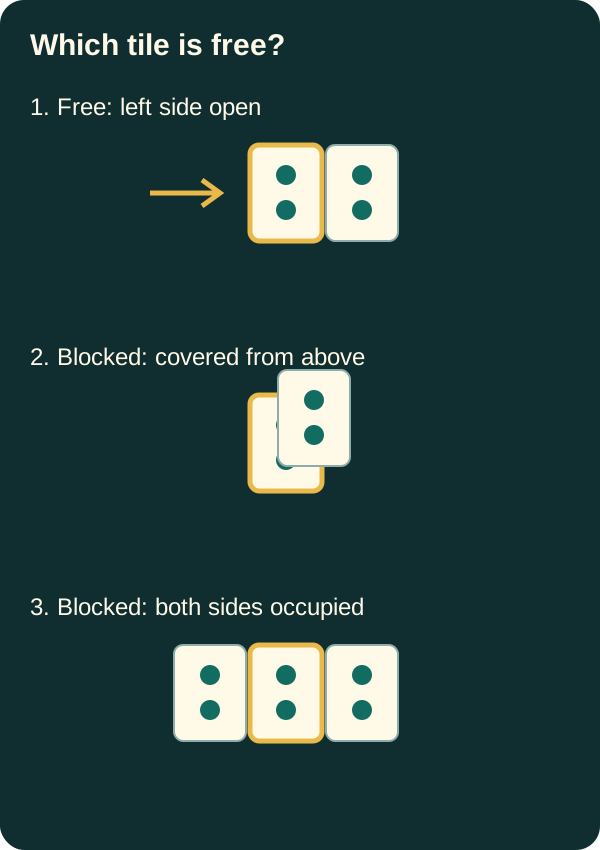
To play Mahjong Solitaire, remove matching pairs of free tiles until the board is empty. A tile is free when nothing covers it and at least one horizontal side—left or right—is open. Both tiles in your pair must meet that rule. You play alone, and the challenge is deciding which pairs will open the most useful space.
Ready to practise? Open free Mahjong Solitaire alongside this guide. The PapoGames version runs in your browser on mobile or desktop, with no download or account required.
Mahjong Solitaire or traditional Mahjong?
Searching “how to play Mahjong” can lead to two different games. Traditional Mahjong is usually a four-player game involving drawing and discarding tiles to build a winning hand. This tutorial teaches Mahjong Solitaire: a single-player tile-matching puzzle with stacked tiles. You do not draw from a wall, discard tiles, declare melds or learn a four-player scoring system.
Mahjong Connect is another distinct matching game: it usually asks you to connect tiles along a path with a limited number of turns. In this game, distance and connecting lines do not matter. Free-tile access and matching faces do.
Mahjong Solitaire rules: what makes a tile free?
- No tile may overlap it from an upper layer. A visible corner or a recognisable face does not make a covered tile selectable.
- At least one horizontal side must be open. Either left or right is enough; both do not need to be open.
- An open top or bottom edge does not replace the left-or-right requirement. A tile with neighbours on both horizontal sides remains blocked.
Which Mahjong tiles match?
Most pairs need exactly the same face. Match the same number in the same suit: a five of dots cannot pair with a five of bamboo. Winds match the same wind, and dragons match the same dragon. Do not use colour alone to decide whether two tiles match.
| Tile family | Matching rule | Example |
|---|---|---|
| Dots, bamboo and characters | Same suit and number | Three of bamboo + three of bamboo |
| Winds and dragons | Same face | East + East; red dragon + red dragon |
| Flowers | Any flower + another flower | Plum + orchid |
| Seasons | Any season + another season | Spring + winter |
Flowers and seasons are separate families: a flower does not match a season. These special tiles can look different and still pair within their own family. They must still both be free. PapoGames uses these family-matching rules; other Mahjong-style games may vary.
How to play your first game, step by step
- Choose a layout and difficulty. PapoGames offers Turtle, Bridge and Pagoda, with 72, 108 or 144 tiles. Start with 72 tiles to practise reading the layers.
- Inspect the upper layers and outer edges. Find two matching tiles that are both uncovered and have a left or right side open.
- Click or tap the first tile, then its partner. A legal pair disappears. You do not drag tiles into a line or move them around the board.
- Pause and inspect the changed board. Removing a pair may uncover a tile below or open the side of a neighbouring tile.
- Repeat until no tiles remain. If tiles remain but no legal pair is available, try undo or shuffle rather than assuming two similar-looking tiles can be forced together.
A simple example: choose the pair that unlocks more tiles
Suppose three identical tiles are free: A sits on a stack, B closes the end of a long row, and C is already isolated. Pairing A with B could uncover a tile and open a row at the same time. Pairing B with C might open only the row. Check what each option actually releases before choosing. This is a planning habit, not a guarantee: the covered tiles and later choices still matter.
Beginner strategy: five useful habits
- Look for access, not just identical pictures. A pair that opens a high stack or a crowded row often creates more options.
- When three or four copies are available, compare possible pairings. Do not automatically take the two nearest tiles.
- Check whether a tile is covering its own partner. Free the upper tile through another matching copy first.
- Keep track of special families. Two different seasons can form a legal pair even when no identical picture is available.
- Recheck the whole board after each removal. Newly opened sides are easy to overlook when your attention stays on one corner.
Hints, undo, shuffle and scoring on PapoGames
A hint points to a currently legal pair; it does not promise that this pair leads to a complete win. Undo reverses the latest removed pair. Shuffle preserves the remaining tile faces and their count, but rearranges and re-stacks their positions into a solvable arrangement. It is a recovery tool, not a move that leaves the layout untouched.
Each removed pair earns 100 points. Hint costs 25 points, undo costs 50 and shuffle costs 100, with a zero floor. Undo also reverses the pair’s 100-point award. The timer records elapsed play: there is no countdown or speed bonus. These are PapoGames features, not universal Mahjong Solitaire scoring rules.
Every starting deal is generated with a solution, but a different removal order can still leave you stuck. If you want to study a choice, undo the last pair and compare the tiles it freed. If you prefer a fresh recovery, shuffle the remaining tiles.
Playing on a phone or with a keyboard
On a phone, tap one tile at a time and use fullscreen if the board feels small. On desktop, you can click tiles or use Tab with Enter or Space; arrow keys move between free tiles, and Escape clears the selection. Take time to inspect the layers before committing to a pair.
Practise the rules in a real board
Start a 72-tile practice game, find one free pair and predict what removing it will unlock. Once that feels comfortable, try a larger board or another layout. For a different kind of pattern practice, browse puzzle games or try Memory, where you remember hidden cards instead of clearing stacked tiles.