To improve at a US state borders quiz, separate two questions: which states touch the current state, and which legal move helps you reach the goal? The first is a neighbor-recall problem. The second is a route-planning problem. A state can be a valid neighbor without being a useful move, and a state that looks close on the map may not touch at all.
Border Run lets you practise both skills. Neighbors asks for the states around a highlighted state. Route asks you to cross the map through states that touch, while the Daily route adds a three-minute limit. The reference table beneath the game lists each state’s neighbors if you want to check an answer after your round.
Start with the game’s definition of a border
Border Run accepts states sharing a boundary or meeting at a point. The important point-contact case is Four Corners: Arizona, Colorado, New Mexico and Utah meet at the same location, as described by Navajo Nation Parks & Recreation. This game counts Arizona–Colorado and Utah–New Mexico as legal neighbor pairs, even though those pairs meet only at the corner.
The quiz does not add neighbors merely because two shorelines face each other across open water. Michigan’s US state neighbors in the game are Wisconsin, Indiana and Ohio. Alaska and Hawaii have no other US state neighbors, so they are not part of the neighbor questions or routes. A game path describes state adjacency, not a driving itinerary.
Use the rule set of the quiz you are playing. Some border exercises count only shared boundary segments and exclude point contacts. Border Run includes the two diagonal Four Corners pairs.
Recall neighbors by walking around the outline
Instead of guessing random nearby names, inspect the state’s outline in a consistent direction. Start at the north side and move around the perimeter. Say each neighbor once, then check narrow corners and short boundary segments. This is especially useful for states with many neighbors, where it is easy to repeat one name and overlook a small contact.
| State | US state neighbors in Border Run | Count |
|---|---|---|
| Maine | New Hampshire | 1 |
| Texas | Arkansas, Louisiana, New Mexico, Oklahoma | 4 |
| Missouri | Arkansas, Illinois, Iowa, Kansas, Kentucky, Nebraska, Oklahoma, Tennessee | 8 |
| Tennessee | Alabama, Arkansas, Georgia, Kentucky, Mississippi, Missouri, North Carolina, Virginia | 8 |
| Alaska and Hawaii | No other US states | 0 each |
Treat the count as a final check, not a substitute for knowing the names. If you have seven neighbors for Missouri, inspect the short contacts near Kentucky and Tennessee before submitting unrelated states. For Texas, do not enter Mexico: it is a country and is outside this US-state quiz.
Neighbors uses one four-minute clock for a round of eight states. Each neighbor you supply correctly is worth 100 points. Revealing the missing neighbors helps you study but does not award their points. Because the questions can have different numbers of neighbors, do not assume every round has the same maximum score.
A worked route: California to Texas
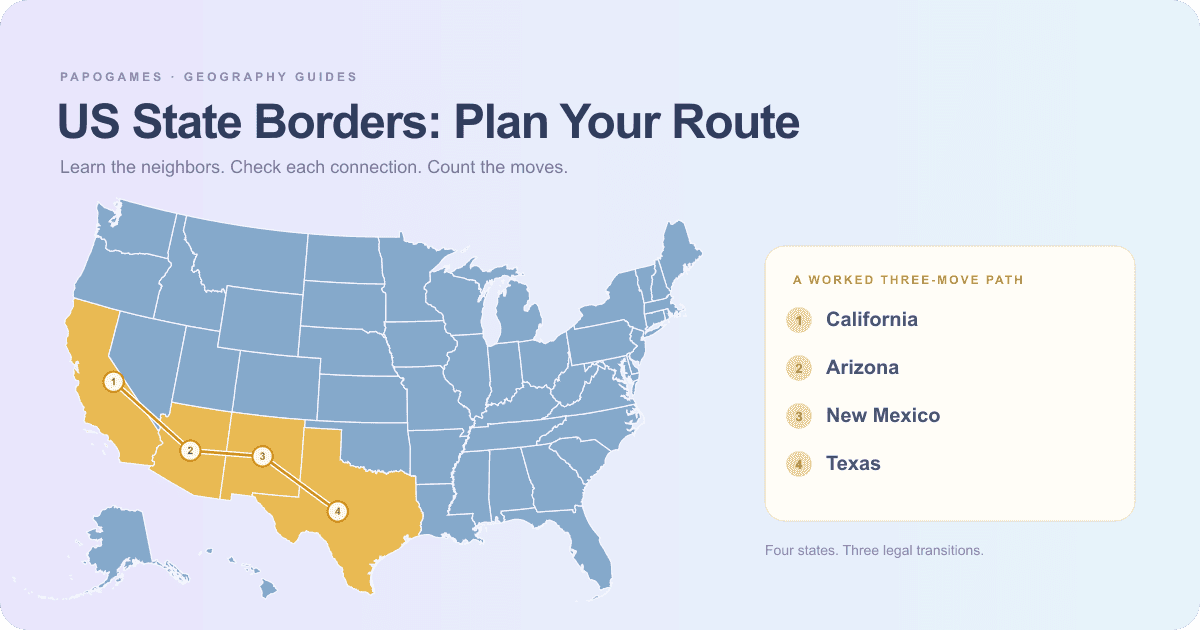
A legal three-move route is California → Arizona → New Mexico → Texas. Count transitions, not the number of names: this path contains four states but only three moves. Every step must touch the state immediately before it; the goal is not available just because it is generally east of the start.
| Move | From | To | Why it works |
|---|---|---|---|
| 1 | California | Arizona | They share a boundary |
| 2 | Arizona | New Mexico | They share a boundary |
| 3 | New Mexico | Texas | They share a boundary |
To plan this backwards, list Texas’s neighbors first. New Mexico is a useful approach from the west. Then ask how to reach New Mexico from California: Arizona connects the two. Working backwards gives you a concrete intermediate target rather than a vague instruction to keep moving east.
You cannot make the California-to-Texas trip in two moves under the game’s rules: none of California’s immediate neighbors also borders Texas. The three-step example therefore matches a shortest route. A different daily start and goal will need a fresh plan; this example is not a shortcut that solves every trip.
Think in connections, not screen distance
A small-looking move on the map can add an unnecessary state, while crossing a large state may be a single move. Border Run measures steps between states, not miles. Before adding a neighbor, compare the next connection it opens toward the destination. Avoid looping back through a state merely because its shape is familiar.
- Check the goal’s neighbors so you know which states can provide the final step.
- Pick an intermediate state you can actually reach from your current position.
- Before confirming a step, verify that the two outlines touch under the game’s rule, including the Four Corners point contacts.
- After finishing, compare your move count with the displayed par. Extra moves reveal where your plan wandered.
An unassisted shortest route with no misses scores 1,000. A route with unnecessary moves, a miss or a hint does not receive that perfect score. That makes the untimed Route mode a useful place to experiment before trying to protect a daily streak.
What makes a Daily route perfect?
The Daily route follows the UTC date, so players get the same start and goal for that date. You have three minutes of active play. To extend the local perfect-run streak, finish on the shortest route, with no misses and no hint. Simply reaching the goal is not enough if you took a detour.
Use a hint when you want to learn an unfamiliar connection, then revisit it in regular Route mode. A hint helps complete the path but marks the round as assisted. Records and the daily streak are saved in this browser; clearing site data removes them.
Build a short review loop
After a difficult round, choose one missed relationship and inspect both states in the neighbor reference. Then name the connection in both directions. Follow it with one short route that uses the same border. This gives the fact a place in a larger path instead of leaving it as an isolated pair to memorize.
Play Border Run to try the method. If the main difficulty is recognizing state names and shapes, use State Sprint and the 50-state memorization plan first. To switch from borders to country comparisons, read the World Balance area and population strategy.